Primroses

Primroses

The Primula genus of over 500 species includes the Wild Primrose Primula vulgaris and the Cowslip Primula veris. Both species are in flower now, in mid March. A natural hybrid between these two species is the False Oxlip (P. veris x vulgaris). It has been used to create a huge number of brightly coloured hybrids and varieties which are border perennials and rockery plants with the common name Polyanthus and the scientific name Primula variabilis. There are also a number of Primula species and cultivars imported from Japan. The Primula genus is a member of the Primrose Family – Primulaceae

wild primrose flowers

Primrose Primula vulgaris  is a common, native wild flower found across Britain in woods and hedge-banks. It is also  found in Western Europe, North Africa and Turkey. It normally flowers from March to May. It often grows close to the base of a tree. Although Primrose and Cowslip flowers look simple they have been the subject of a huge amount of study because populations have two morphs – known as  ‘pin-eyed’ (long style) and ‘thrum-eyed’ (short-style). This is known as heterostyly. 
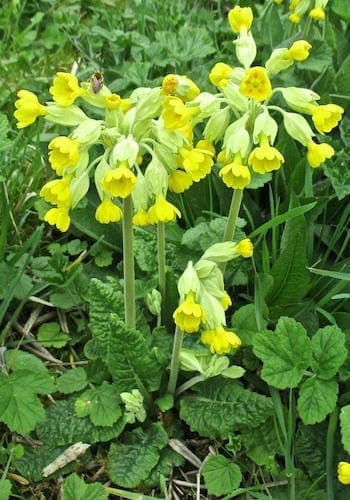
cowslip flowers

Cowslip Primula veris has multiple flowers on one stalk arranged in an umbel. A less-common native wild flower found across Britain in meadows and pastures and in Europe and temperate Asia. It normally flowers from April to May but this year is already in flower in a few places. In old meadows it can be prolific in April.
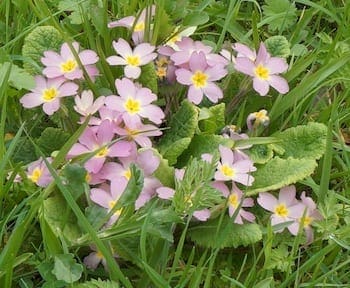
bird's-eye primrose flowers

Bird’s-eye Primrose Primula farinosa is a rarer native wild flower found in damp meadows on limestone in Northern England, Europe and Asia. It flowers from May to June.

polyanthus crescendo wine flowers

Primula ‘Crescendo Wine’ is a popular Polyanthus 

japanese primrose flowers

Japanese Primrose Primula japonica is a species native to Japan. It was introduced to Britain in 1871 by Robert Fortune, the Scottish botanist.

Japanese Primrose 'Miller's Crimson’ flowers

Japanese Primrose ‘Miller’s Crimson’  is a popular cultivar.

Wych Elm flowers and fruit

Wych Elm flowers and fruit

Wych Elm flowers and fruit.

Normally the Wych Elm Ulmus glabra produces flowers in March and  fruit  in April before the leaves. This year the fruit is already on the tree in early March. The fruit is bright green when formed but turns yellow and is shed in May and June. The Wych Elm is native to Britain and recognised by its very large leaves. It grows well in upland areas and is common in Scotland. It is susceptible to Dutch Elm Disease but isolated old trees or clumps of trees still survive. It is the mature  elm you are most likely to see.

Wych Elm in March

This photo shows a Wych Elm tree in March. 

Wych Elm fruit

At first sight the tree appears to be in leaf but, as this close-up photo shows, the branches are actually covered in fruit which is in the form of winged seeds called samaras.

wych Elm flower male phase

A close-up of a cluster of flowers at the end of March. The flowers come out before the leaves. The flowers of all Elms are wind pollinated so do not have colourful petals to attract insects. There are 8 to 10 flowers in each cluster. Each flower has male and female parts. The male dark red anthers stick out from the female ovary which can’t be seen in this photo. The anthers split open to release pollen onto the wind before the female stigmas are receptive to avoid self-pollination. There are usually 4 anthers per flower. 

Wych Elm fruit

Close-up of the fruit which has formed from the ovary 3 weeks later. At the tip of each flat fruit are the remains of the 2 pink styles. The seeds of the wych elm are surrounded by a flat wing to help wind dispersion. A winged seed of this type is called a samara by botanists. Photo taken in mid April.

Wych Elm fruit in April

Fruit in April

Wych Elm fruit in June

Fruit in June


Blackthorn Flowers

Blackthorn Flowers

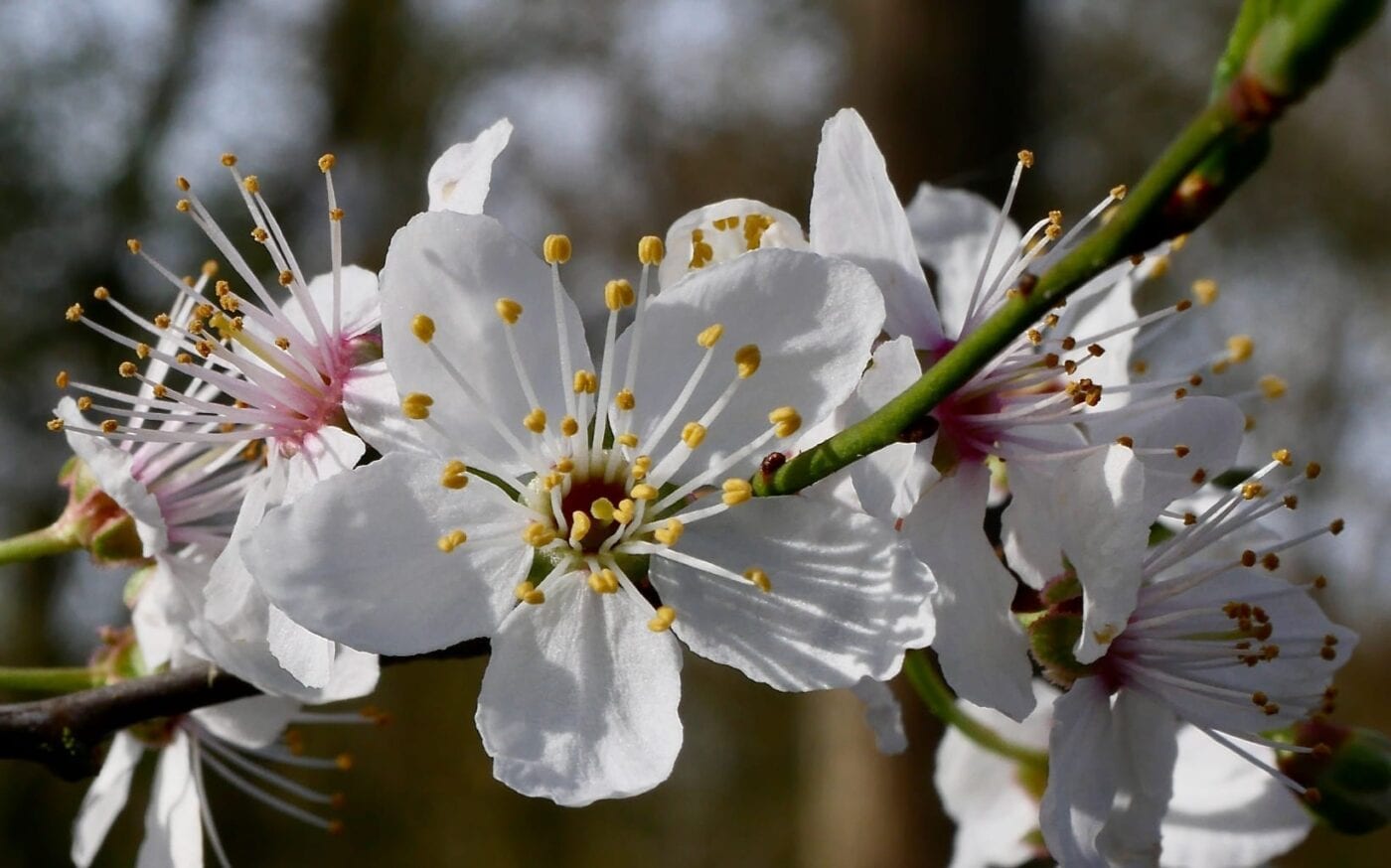
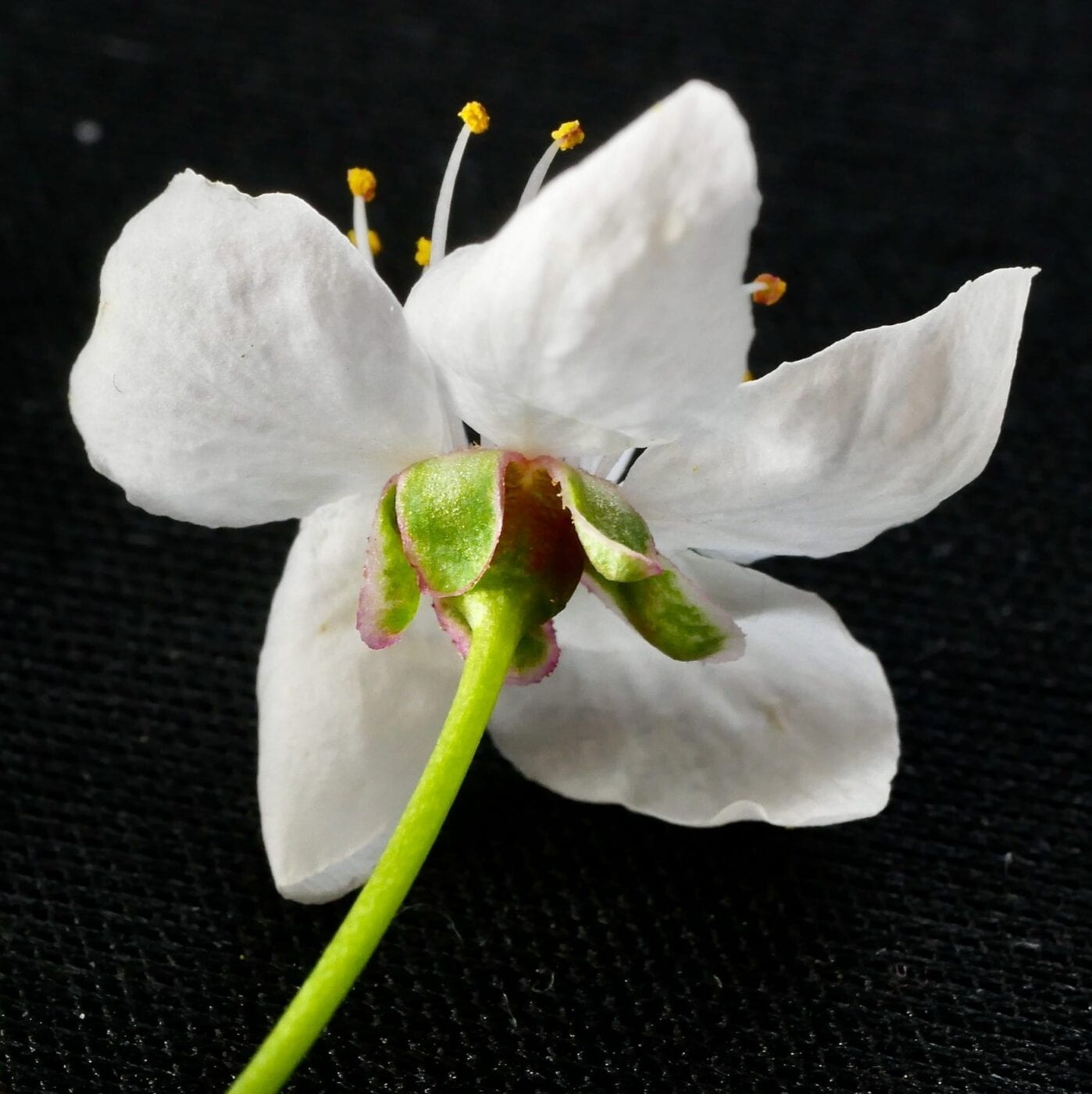
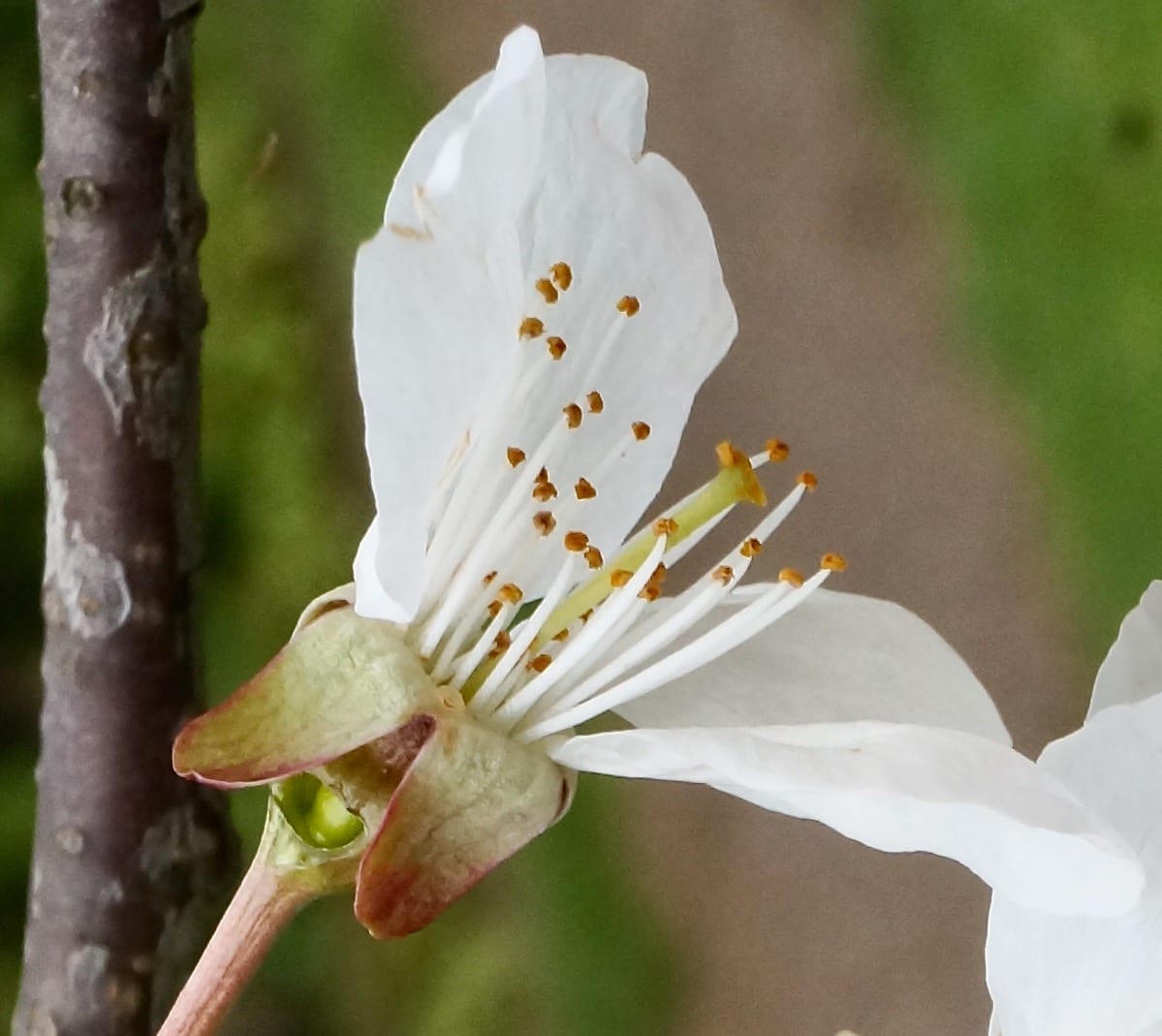
Three closely related trees have white flowers in spring – Cherry Plum, Blackthorn and Wild Cherry. They are all members of the Prunus genus in the Rose Family and have very similar flowers. The Prunus genus of over 400 species of trees and shrubs includes Wild Cherry, Flowering Cherries, Plum, Apricot, Peach, Almond,  Blackthorn  and Bird Cherry. These three species have flowering periods that may overlap and they can easily be confused. Each flower has 5 green sepals, 5 white petals, many yellow anthers and 1 green style. The sepals lie under the petals and have evolved to protect the bud before flowering. Their shape after flowering is the key to correct identification. One other difference is that Cherry Plum and Blackthorn flowers are ‘solitary’ (one bud produces 1 flower) but Wild Cherry flowers are in the form of an ‘umbel’ where one bud produces a number of flowers.

Cherry Plum flowers

Cherry Plum flowers are produced from February to April. For more information click here 

Blackthorn flowers
Blackthorn flowers are produced from March to April. For more information click here.
Wild Cherry flowers

Wild Cherry flowers are produced from April to May. For more information click here.

Cherry Plum sepals

The sepals of the Cherry Plum are ‘reflexed’ i.e. bent backwards.

Blackthorn sepals

The sepals of the Blackthorn are not reflexed i.e. not bent backwards.

Wild Cherry sepals

The sepals of the Wild Cherry are ‘reflexed’ i.e. bent backwards like the Cherry Plum.

Early Flowering Magnolia

Early Flowering Magnolia

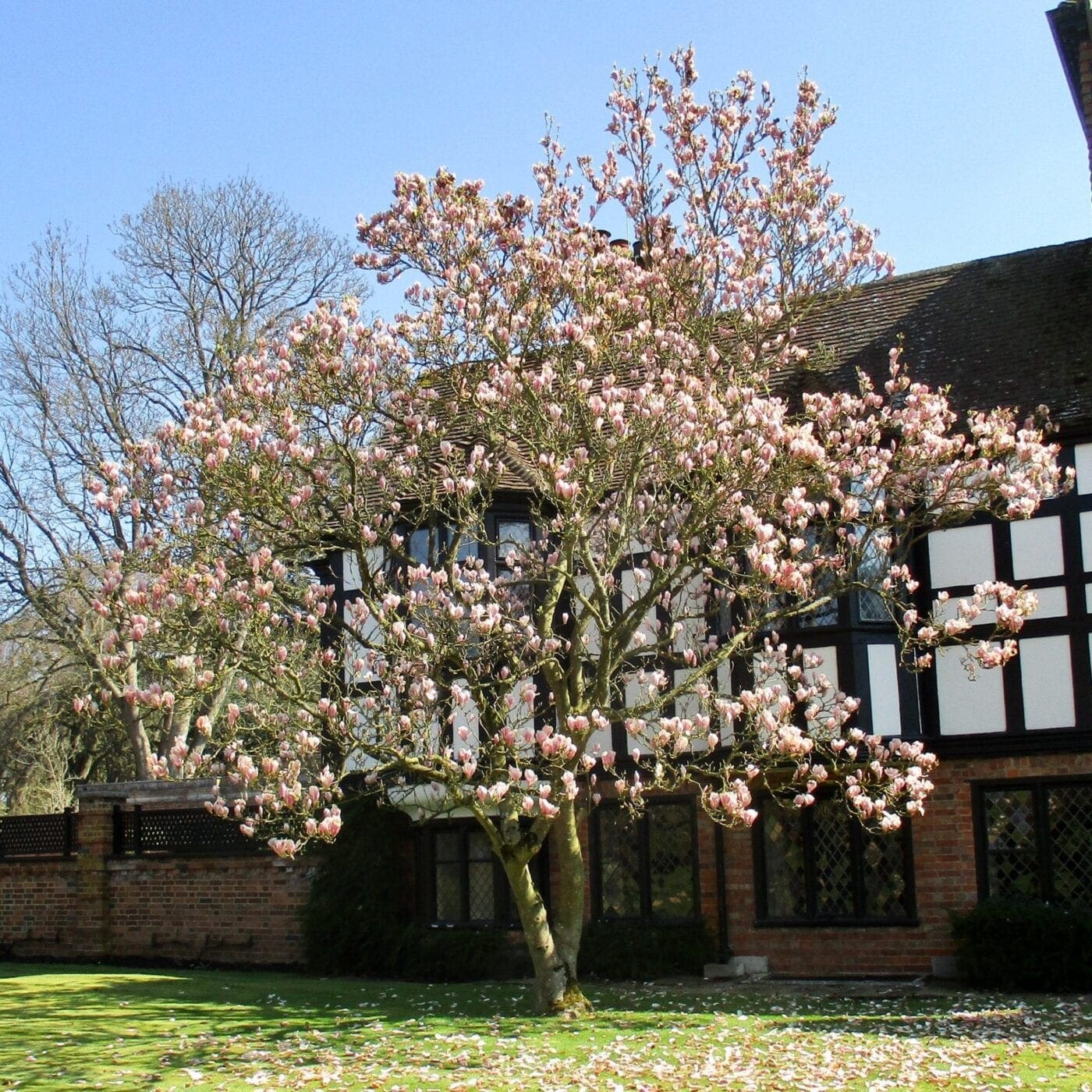
The Saucer Magnolia (Magnolia x soulangeana) is already in flower in London, following the mild winter. Magnolia trees and shrubs are members of a very large genus containing between 120 and 230 species depending on the classification system used. The genus is named after the French botanist Pierre Magnol. It is an ancient genus with ‘primitive’ flowers adapted for pollination by beetles. The petals, for example, are known as tepals because the sepals and petals are indistinguishable. This is a feature common to plants that appeared early on in the evolution of Flowering Plants. Magnolias are important horticulturally. They are now sold worldwide and many new varieties have been developed. They are grown for their beautiful flowers and their striking foliage. Two common Magnolias – the Saucer Magnolia and Star Magnolia flower in Spring and the Southern Evergreen Magnolia flowers from midsummer. See a previous post for more information. 


Saucer Magnolia tree

The Saucer Magnolia, a deciduous shrub or small tree, is a hybrid between two Chinese species, Magnolia denudata (Yulan), which has white flowers and Magnolia liliflora, which has purple and white flowers. It was initially bred in 1820 in France by a retired cavalry officer Etienne Soulange-Bodin and was introduced to Britain in 1827. It is now the most popular and well-known form of Magnolia, widely planted in parks and gardens. It flowers in early spring, then through the summer. Photo taken in April 11 2019

Saucer Magnolia flower

Vase-like flowers first emerge in March, before the leaves but continue to emerge through the summer. Flowers are white with a pink or purple stain. Photo taken March 19th 2014. This year some flowers are already out in February.

Saucer Magnolia flower styles and stigmas

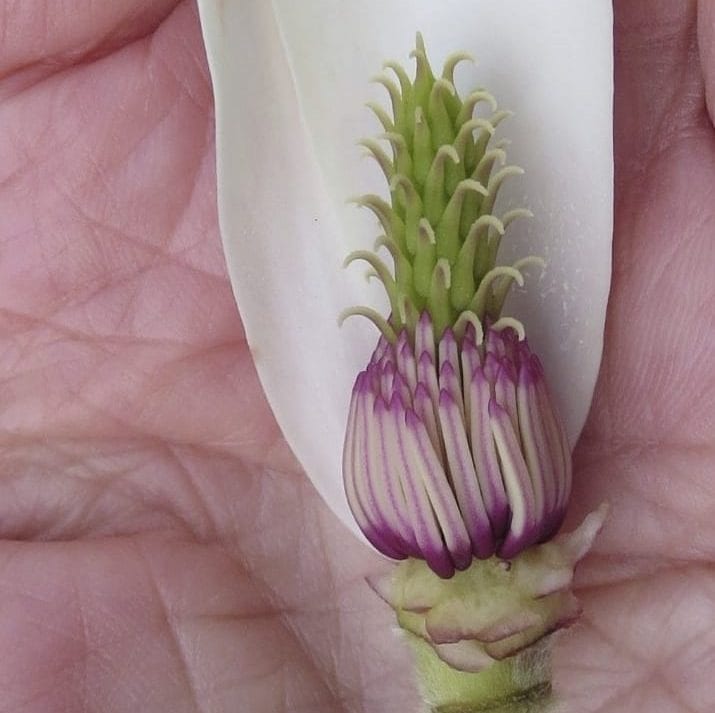
In this photo some of the tepals have been removed to show the purple anthers and green styles of the sexual parts of the flower. The anthers release male pollen grains. Each style is connected to an ovary. For pollination to occur a pollen grain from another tree must land on the style.

Saucer Magnolia flower after pollen release

Close-up of the flower centre after the pollen grains have been released by the anthers. In Magnolias pollination is mainly carried out by beetles. They are attracted to the flower by sweet-smelling secretions and may shelter and feed in the centre of the flower for several hours. If the anthers release pollen during this time, the beetle gets contaminated with pollen grains. Eventually the inner tepals open and release the beetle which then flies off to other trees and pollinates them.

Silver Maple Red Flowers

Silver Maple Red Flowers

The Silver Maple Acer saccharinum is native to eastern and central North America from Newfoundland to Texas. It was introduced to Britain in 1725 and has been widely planted on city streets and parks. Its leaves are silvery underneath and it has bright red flowers in spring, before the leaves. All images and text taken from the book Field Guide to the Trees of Britain and Europe or the app Tree Guide UK
Silver Maple flowers in February

The tree comes into flower before the leaves, normally in March,  but this year in February following the mild winter. The tree in this photos has only female flowers.

Silver Maple female flower bud

A female flower bud that has just opened. Some trees have all female flowers, some all male and some have both. The flowers are wind-pollinated so have no petals. Each bud opens to reveal several flowers. A single female flower extends 2 long red stigmas to catch wind-blown pollen. They are connected to a single ovary which eventually forms a 2-winged fruit called a samara. The fruits hang down like a Sycamore. 

Silver Maple female flower buds

Female flower buds are located along or at the end of twigs.

Silver Maple female flower buds

When the female flower bud first opens the stigmas are white, then turn red.

More February Flowers

More February Flowers

Following the mild winter, some  flowers are out in February that normally would not be seen until March. Two wild flowers,  the Lesser celandine and the Coltsfoot are in flower as are two trees, the Cherry Plum with white flowers and the Goat Willow with yellow catkins.

Lesser Celandine flower

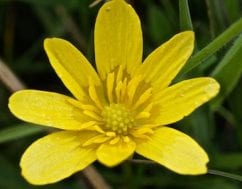
Lesser celandine Ranunculus ficaria is a native wild flower found in shady areas by streams throughout Britain. It is pollinated by flies and bees. It normally flowers from March to May. It has heart-shaped leaves and 8 to 12 petals. Anthers release pollen before the stigma is receptive but if no insects are present the plant will self-pollinate.

Coltsfoot flower

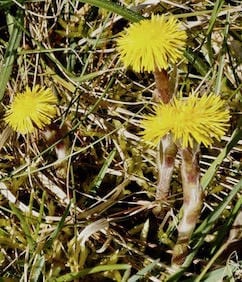
Coltsfoot Tussilago farfara is generally considered a weed, growing on waste ground, arable fields and bare places. It flowers before the leaves, as shown here. When the heart-shaped leaves appear they are similar to, but smaller than, those of the Butterbur. It is a member of the Daisy family.

Cherry Plum tree

The Cherry Plum is also known as the Myrobalan Plum. It is native to a region from the Balkans to central Asia and has been cultivated in Britain from the 16th century.  It is a thorny shrub or small tree and is frequently planted in urban areas because it is one of the first trees to come into flower in the spring.  It is often confused with the Blackthorn. 

Goat Willow catkin

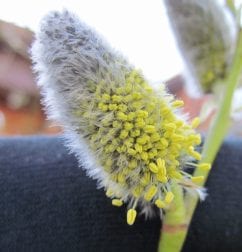
The Goat Willow is a shrub or small tree also known as Pussy Willow and Great Sallow. It is native to Europe (including Britain) and Asia. In Britain it is found everywhere in woodlands, scrub and hedgerows. The male catkins are yellow when full of pollen in March and April.