Dwarf Cherry

Dwarf Cherry

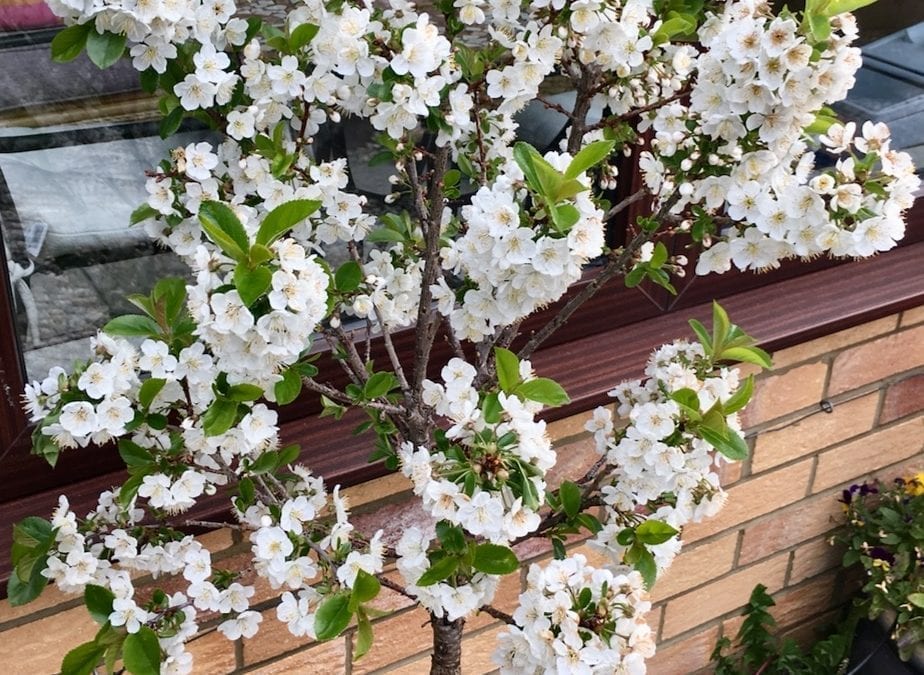
A year in pictures in the life of a Dwarf Cherry tree located on a south-facing patio. Bought in 2018 it did not fruit in the first year, then in 2019 produced its first crop. A dwarf fruit tree is exactly like any other  fruit tree but its genome restricts its growth to less than 1.5m. It produces flowers, leaves and fruit exactly the same as any other fertile cherry tree. This particular variety of cherry is self-pollinating so does not need another similar tree nearby. Clearly these trees produces masses of flowers but only a small percentage develop into fruits. The flower and leaf buds are formed in the autumn and if they survive the winter,  the flowers emerge first in spring, closely followed by the leaves. The flowers came out slightly earlier this year than last. Last year by June the fruit had formed and was ripe by mid July. The leaves turned red by November and this year the buds were getting ready to open in March and it now in full flower.


April 16th 2019

June 1st 2019

July 13th 2019

The fruit is botanically classified as a drupe which consists of three of the ovary wall layers – an outer skin, a fleshy middle layer and an inner stony layer which surrounds the seed. Cherry, Blackthorn, Olive, Apricot, Peach and  Plum fruits are drupes. 

October 25th 2019

March 16th 2020


April 9th 2020

Hornbeam

Hornbeam

The Common Hornbeam Carpinus betulus is native to Southern England and is also found throughout Europe and Turkey. It is a medium-sized tree and can grow to 30m. It is common in hedgerows and woods and has been planted in many parks and gardens. Its wood is too hard to be used in general carpentry but has been used in hard wearing tasks such as chopping blocks and cog-wheels. In Epping Forest Hornbeams were pollarded to provide firewood. The tree can be confused with the Common Beech but its oval leaves are toothed not smooth-edged. The bark of the tree is very unusual. It is smooth, like the Beech, but is patterned with distinctive silver-grey vertical lines. Male catkins appear in spring and the bracts that held the fruit hang on the tree through winter. 

common hornbeam tree in august

A mature Common Hornbeam in August.

common hornbeam leaf
The leaf has a very fine point at the end which is sometimes twisted over. The leaf is toothed unlike the Beech leaf which is smooth-edged.
common hornbeam bark
The bark has silvery-grey vertical patterns that are very distinctive.
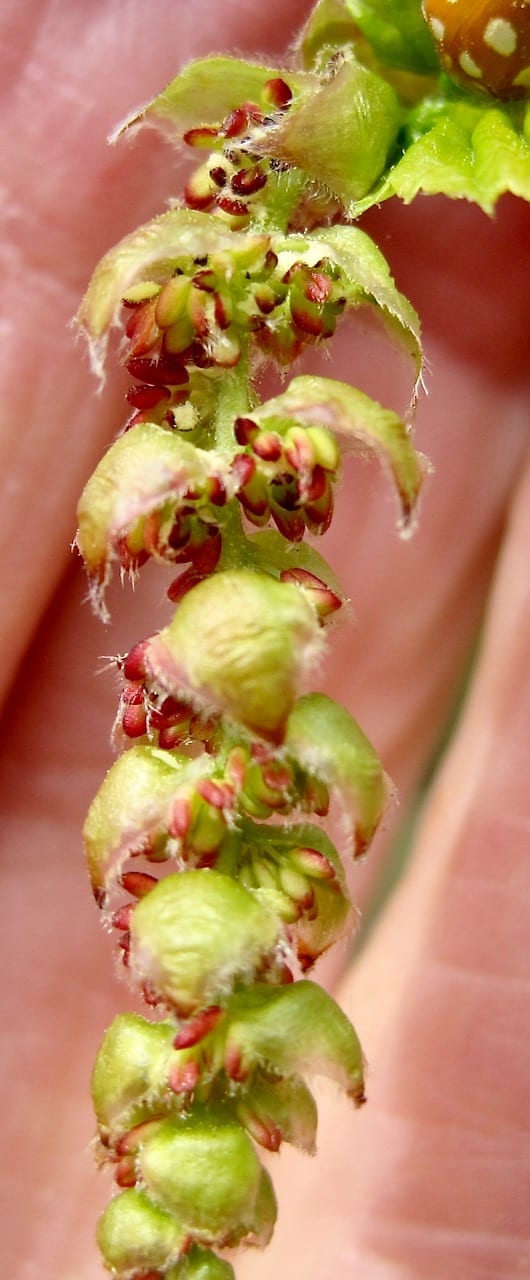
common hornbeam male catkin
This close-up of a male catkin shows the red ‘anthers’ ready to split open and release pollen on to the wind in mid April. Trees bear both male and female catkins and so are Monoecious.
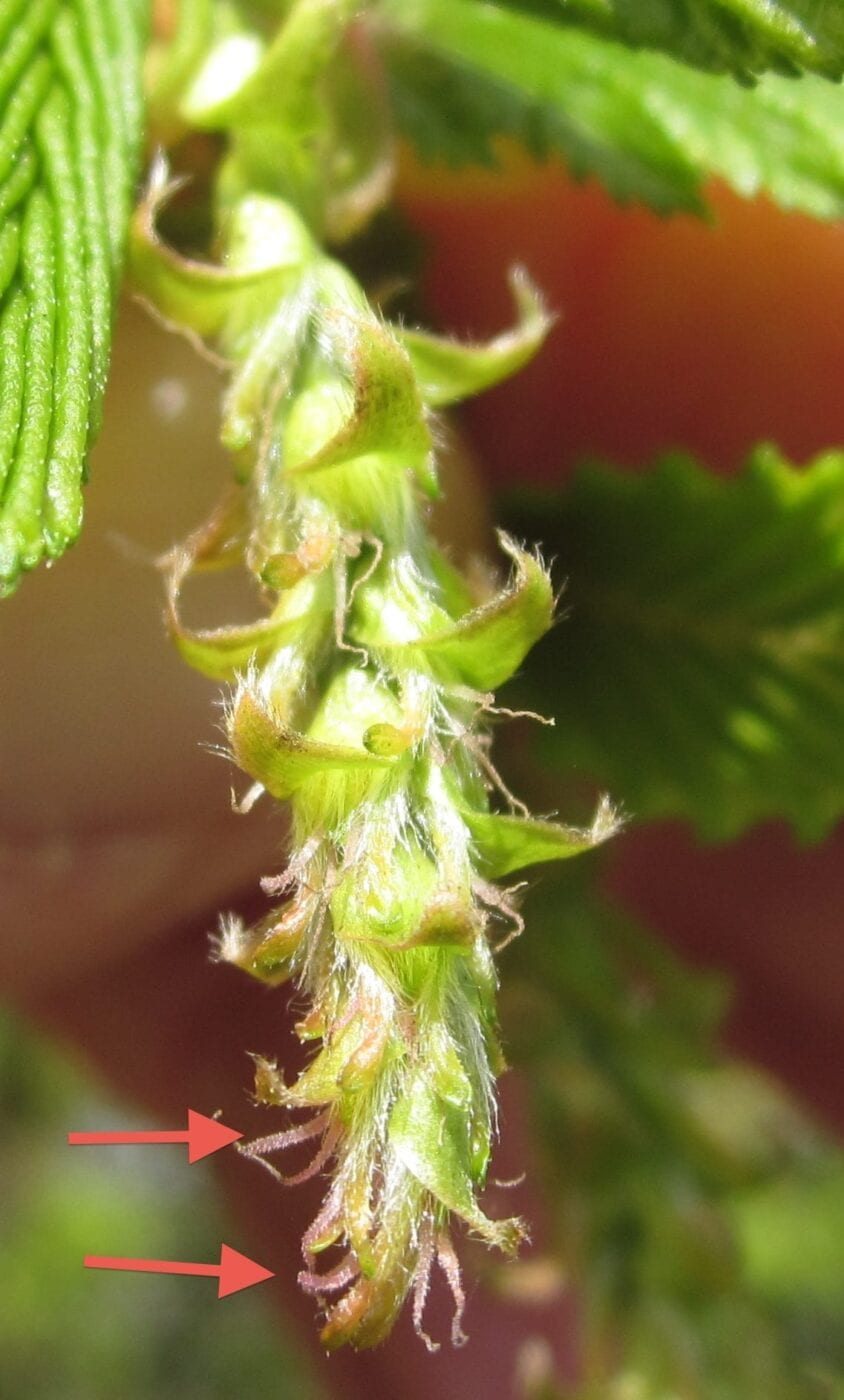
common hornbeam female catkin
Close-up of a female catkin in April. The flower is not quite ready to receive pollen. When it is, the flower ‘styles’ (shown arrowed) will turn red.
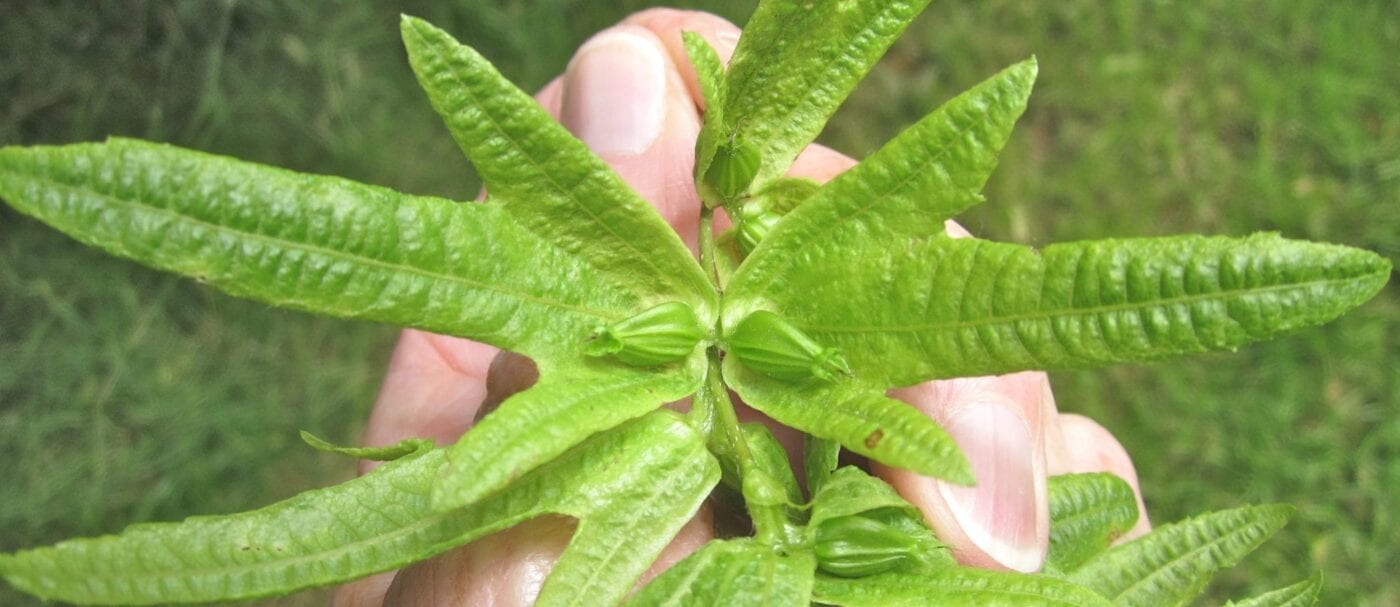
common hornbeam fruit
The fruit develops from the female catkin by August. The fruit is a nut. They are very small  and are difficult to see. Less than 1 cm long, they fall when ripe and are carried by the wind. They are eaten by mice and voles. The nuts are located at the junction between the pairs of 3-lobed ‘bracts’.
common hornbeam bracts in winter
After the nuts have dropped out the ‘bracts’ stay on the tree all winter. Photo taken in December.
Tulips

Tulips

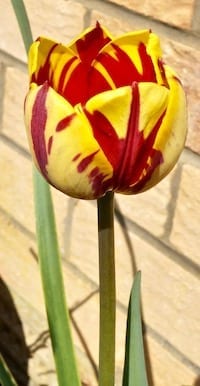
Tulips are coming into flower now. Tulips are members of the Lily family. The Tulipa (Tulip) genus with  about 75 species is native to mountainous areas of Eurasia and North Africa. The main area of diversity is Central Asia. Some species and many cultivars are planted in ornamental gardens where they are prized for their spring flowers. Early cultivars were developed in Persia in the 10th century and were common in the gardens of the Ottoman Empire. Introduced to Europe in the 16th century and Britain in 1578, they became incredibly popular in The Netherlands  in the 1630s in what became known as ‘tulip mania’. Today The Netherlands are the world’s main producers of tulip bulbs. Variegated tulips (example shown below) were originally formed as a result of viral infection but are now stable variants produced by long breeding programmes. 

Tulip

Tulip ‘Apeldoorn’ Tulipa ‘Apeldoorn’, was introduced in 1951. It’s a member of the Darwin Hybrid group, known for their regal stature (they are amongst the tallest tulips), their huge blooms in vivid colours and their ability to flower strongly year after year.

tulip flower section

Tulip flowers are symmetrical and bi-sexual with 6 petals  and 6 stamens and a single style with 3 lobes. Pollination is by insects, mainly bees. They visit the flowers to collect pollen. Tulips do not produce nectar. The photo above is of a flower with 3 petals removed showing the stigma sitting on the superior ovary surrounded by 4 of its 6 stamens (with anthers). The difference in height between the stigma and anthers is small so self pollination may occur if insect cross -pollination fails, for example in cold wet weather.

tulip variegated

Modern cultivars are primarily based on Tulipa gesneriana. Darwin hybrids are crosses between this species and T fosteriana. Tulip species hybridise easily but most commercial cultivars are sterile. This photo shows a modern variegated cultivar. There are 15 different categories of tulip cultivars registered by the RHS.

wild tulip flower

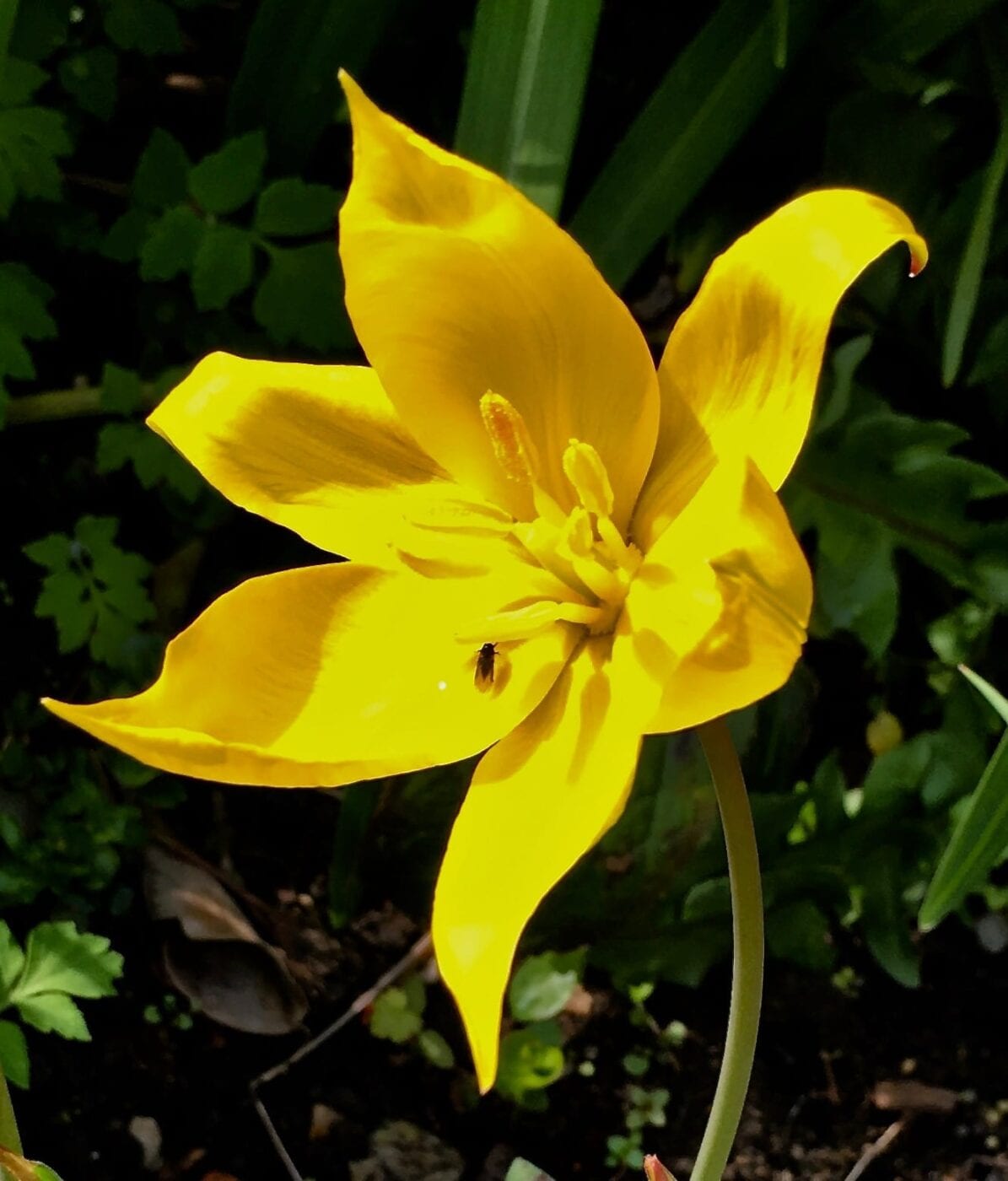
Wild Tulip Tulipa sylvestris is a yellow tulip introduced to Britain  in the 16th century and now found in meadows and orchards in southern and eastern Britain. It is native to Eurasia and North Africa.

March Flowers

March Flowers

At the moment, in late March, two attractive garden plants are  in flower – the Garden Anemone and the popular Wallflower ‘Bowles’s Mauve’ . Two trees have also recently come into flower – the Wild Cherry and the Norway Maple. Some early flowering cherries may already be in flower but late frosts may spoil the blossom.


garden anemone flower

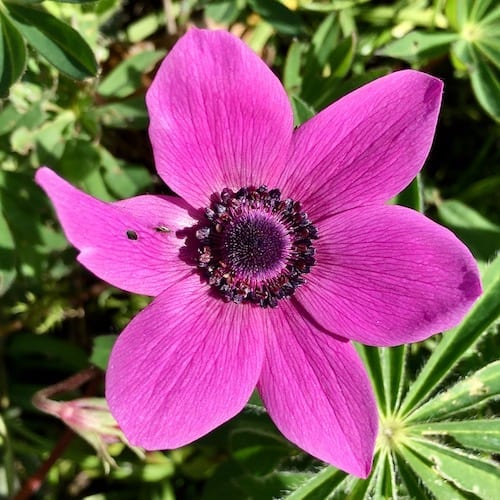
The Garden Anemone  is a species native to the Mediterranean region. It is a member of the Buttercup family and has the typical flower of that family. The flower is insect pollinated and provides large amounts of pollen from its numerous dark purple anthers. The flower shown here is a hybrid “Sylphide’ one of the De Caen group of hybrids sold as Garden Poppies. 


wallflower flower

The Wallflower Bowles’s Mauve’  is a sterile, short-lived shrubby perennial that can be propagated from cuttings and is very attractive to butterflies. This is one of the most popular wallflower cultivars. Wallflowers are members of the Cabbage family in which flowers have 4 petals in the form of a cross, hence the old Latin name for the family of  Cruciferae.

wild cherry flowers

The Wild Cherry Prunus avium is a tree native to Britain, Western Europe to the Caucasus, the Middle East, and North Africa. The flowers, produced by one bud, are in the form of an umbel in which all flowers come from one point. The Wild Cherry  is the species  from which all the flowering cherries are derived. See this previous post for more information on cherries.

norway maple flowers

The Norway Maple is a tree native to Europe, from Scandinavia to the Caucasus. It was introduced to Britain in 1683 and is now commonly found in gardens, streets and parks. It is one of the first trees to look green in spring, when its green flowers, shown above, open before the leaves. 

Pears

Pears

PEAR TREES

Pear trees come into flower in March. The Common Pear and the Callery Pear have identical white flowers but the Callery Pear is sterile and does not bear fruit. They can be confused at a distance with the Crab Apple but they flower 2 to 4 weeks before the Apple. 

Common Pear tree

The Common Pear Pyrus communis is native to Europe and the Middle East. It was probably introduced to Britain but now grows wild usually as an isolated tree but  has also been planted in  parks, orchards and gardens.  It is a large tree from which most of the cultivated pears have been developed. There are thousands of varieties in cultivation such as ‘Conference’ – the most popular commercial variety in Britain and ‘Doyenne du Comice’ developed in France. More than 3000 cultivated varieties have been developed, based on just a few wild species.

Callery Pear tree

The Callery Pear is native to China and Vietnam. It was introduced to Britain in 1908. In the form of one of its cultivars ‘Chanticleer’, this ornamental pear can now be found on many streets. It is compact, flowers early and has a very late autumn colour. Its fruit is small, hard and insignificant.

Common Pear flowers

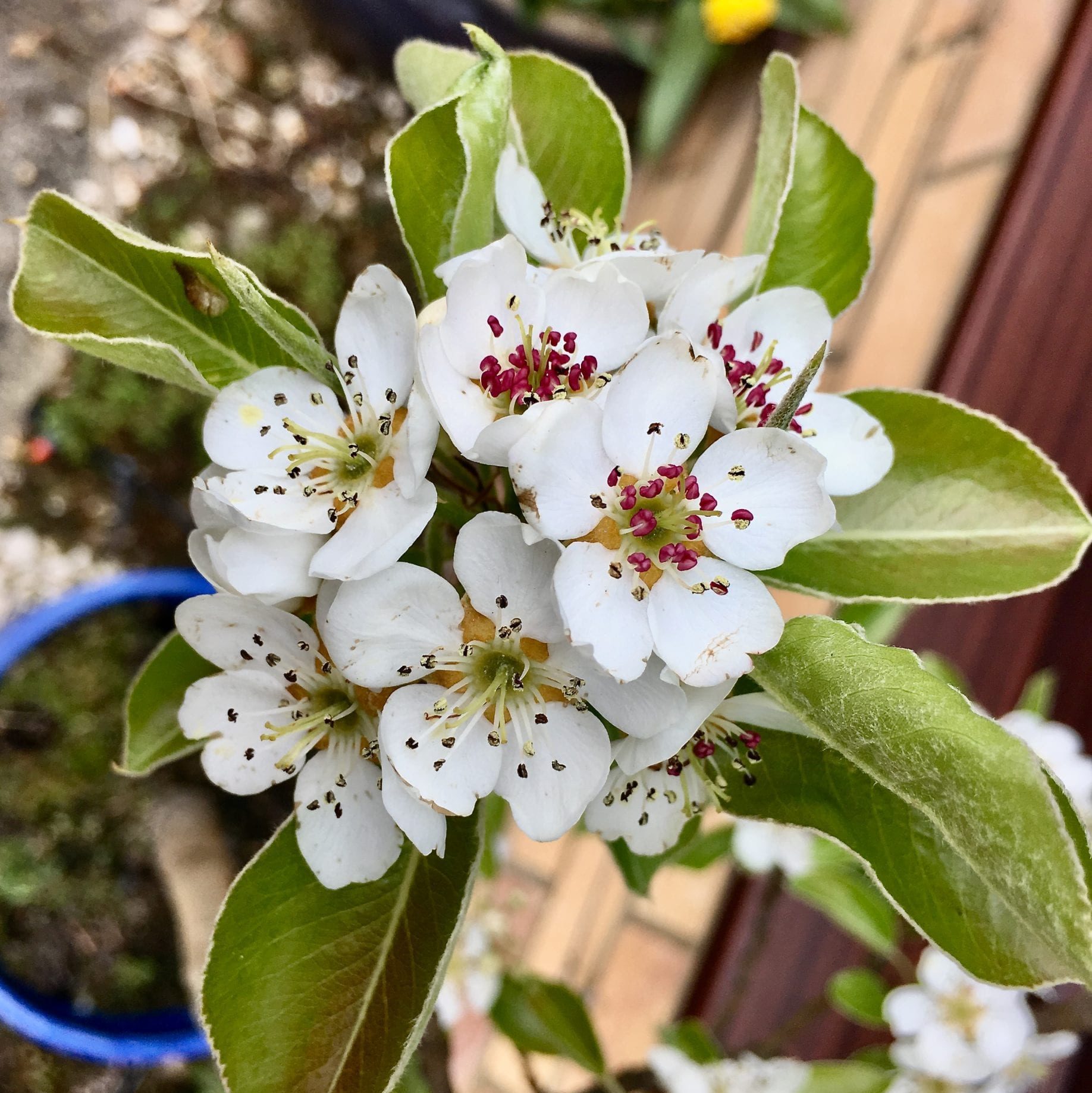
The Common Pear flowers emerge along with the first leaves and are about one inch across. The flowers come out at the end of March or early April. Each flower has 5 white petals, numerous red  anthers and 5 yellow stigmas. In this photo, taken in March 2019 the anthers of the flowers at the top are red but dark purple after releasing pollen in flowers lower down.

Common Pear flower

When the Common Pear flowers open, the stamens with their red anthers are bent inward and do not reach the height of the yellow stigmas. The stigmas become receptive before the anthers release their pollen, and as the stamens mature they straighten, placing the anthers at the same height as the stigmas. At this point, the anthers release their pollen and  turn dark red. The flowers are pollinated by various flies and bees but will self-pollinate if none are about. This photo was taken at the end of March 2019. Th learn more about pollination and flower parts click here

Common Pear fruit

In this photo, taken in May, the Common Pear ovary has started to grow into a fruit called a Pome.  The petals have now withered along with the anthers and styles. 

Common Pear fruit

In this photo, taken in July, the Common Pear fruit is almost ready to be picked.

Common Pear buds are small and pointed and covered in white hairs

Close-up of a Callery Pear bud

Violets and Pansies

Violets and Pansies

Violets and Pansies are members of the Viola genus which is in  the Violet family Violaceae. Viola is the ancient Latin name for the  Sweet Violet   Viola odorata used by the Greeks to make perfumes and the Romans to make wine. It has a very distinctive scent which is still used today in perfumes. The Common Dog Violet is in flower now.  Garden pansies are hybrids of several species, including the Wild Pansy Viola tricolor. Text and images are taken from the new eBook ‘Flowers’ which was published recently. Click on this link for more information on the eBook.

common dog violet flowers

The Common Dog Violet Viola riviniana is a wild flower native to Britain. It flowers from March to May and is found in woods, grassy places, gardens and mountains. Its flowers are very small and easily missed.  Its flower is complex with a nectar spur to attract pollinators.

The tiny flower is remarkably complex. The flower has 5 unequal sized  petals – a front petal with a long grey spur behind it, 2 petals either side  and 2 petals above.   Secreted nectar collects in the petal spur.  When a pollinator, such as a bumble bee,  alights on the front petal and extends its proboscis towards the nectar in the petal spur it inadvertently touches the reproductive parts and pollinates the flower. A complex arrangement of anthers and stigma prevents self-pollination.

wild pansy flower

The Wild Pansy Viola tricolor is a native wild flower found growing throughout Britain on field margins and short grasslands. It is also common throughout Europe as far as the Caucasus. It flowers from May to September and is pollinated by long-tongued bees. It is also known as Heartsease and referred to by Shakespeare as a pansy. The flower has 5 petals, 2 blue upper and 3 white/yellow lower and has nectaries in a spur. 

garden pansy flower

The Garden Pansy Viola x wittrockiana is a hybrid of several viola species, including the wild pansy. It was created in the 1830s in Britain and named after a Swedish botanist. It has 2 upper petals, 2 side petals and one large lower petal. They are treated as hardy annuals although they are biennials and will produce seed in their second year. Generally they are grown from seed and planted out in the second year, then discarded.