Lime Tree Flowers

Lime Tree Flowers

There are three species of Lime that flower in June and July. The Broad-leaved Lime is native to Europe and Western Asia. It was probably introduced to Britain but now grows naturally in the lime rich soils such as those of the Wye Valley and parts of the Pennines. It flowers in June. The Small-leaved Lime is native to Europe, including Britain. It grows naturally in old woods and hedges in England and Wales as far north as the Lake District and some varieties have been planted in  gardens and streets. It flowers in July. The Common Lime is a natural hybrid of the Broad-leaved Lime and the Small-leaved Lime and grows across Europe wherever these two are present. In Britain it has been planted everywhere in streets, parks, churchyards and formal gardens. The Common Lime flowers after the Broad-leaved Lime, usually in July.

Lime tree flowers and fruit are always attached to a pale green, odd-shaped leaf called a bract. The number of flowers and fruit per bract varies between Lime species but they are all arranged in a branched structure called a cyme. 

Lime trees do not produce the citrus fruits we know as limes. They come from a small tree with the scientific name Citrus aurantifolia, which originates in Southeast Asia. The word lime, as used for trees in Britain is believed to come from the Old English word lind.

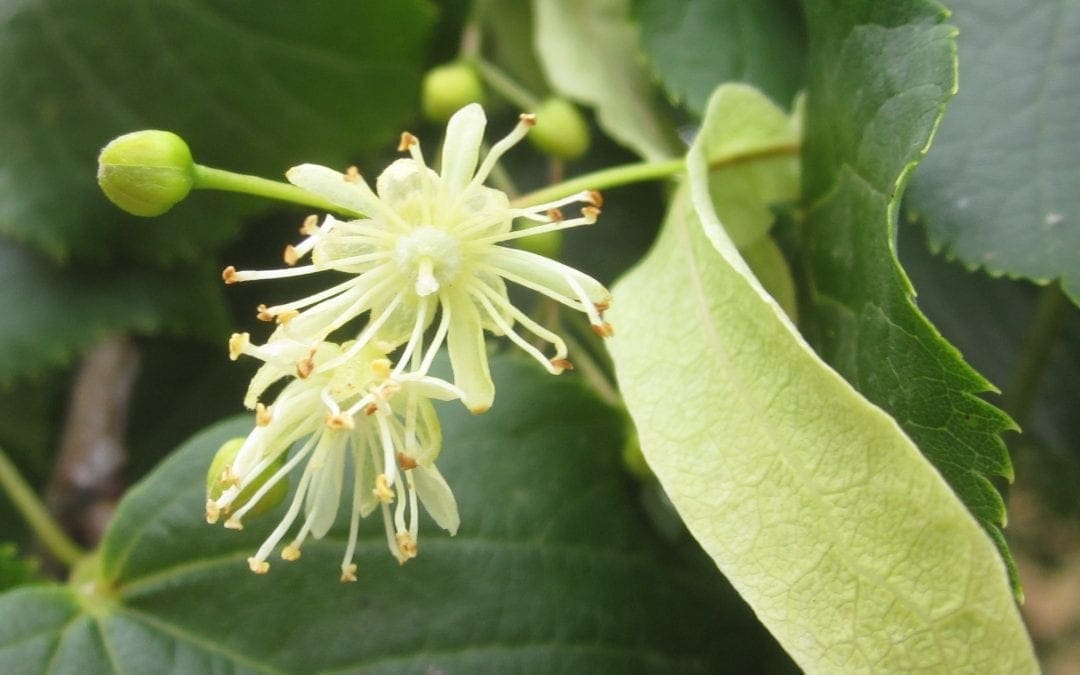
The Broad-leaved lime is the first lime to come into flower, usually in June. This photograph was taken on June 4th. The flower has both male and female parts. The male anthers are yellow, the female stigma and ovary are white.

The fruit of the Broad-leaved lime is strongly ribbed. The 5 ribs can easily be seen by mid September.

The flowers of the Small-leaved Lime stick out at all angles from the bract, whereas on other limes they hang down. Some flowers come out at in early July. There are from 5-11 per bract. 

Flowers of the Small-leaved Lime develop into fruit by mid August

Flowers of the Common Lime come out in July. Each flower has a white Stigma, Style and Ovary, which is surrounded by yellow or brown anthers. 

Fruit of the Common Lime at the end of July. There are 4 to 10 per bract. The fruit are not ribbed like Broad-leaved Lime fruit.

Elder

Elder

The Elder Sambucus nigra is a shrub or small tree found in hedgerows and woods throughout Britain. It is also known as the Elderberry.  It is also native to Europe, North Africa and south-west Asia. The fruit is used to make wine and has many medicinal uses, but the seeds and other plant parts are toxic. It is easily recognised in spring when it bears flat plates of white flowers and in autumn from its black berries. In winter it has distinctive branches with big purple buds. It has long been known for its medicinal properties and its stems have been used to make whistles and pipes, but it also became associated with witches, magic and folklore. To burn elder wood was thought to bring bad luck. On the other hand it could be used ward off witches and make magic wands.

Elder in flower

An Elder Shrub in mid June

Elder flower cluster

The flowers are in flat-topped clusters called compound  cymes by botanists.  Photo taken at the end of June.

Elder pinnate leaf

There are 5 to 7 tooth-edged leaflets on each leaf. This is a pinnate leaf. The  buds and leaves are in opposite pairs. The buds in winter are large and purple and look ragged. For more photos click HERE.

Elder fruit

Fruit in late September. The complexity of the branching system can be seen here.


Plane Tree Flowers

Plane Tree Flowers

The London Plane (Platanus x hispanica) is probably a hybrid between the Oriental Plane and the American Sycamore, first created in Spain or southern France in about 1650. It was introduced to Britain in about 1680. It is now common in large gardens and parks and very common on city streets where it has proved resistant to pollution.  The flowers and  fruit are unusual. The tree is monoecious and has globular male and female flower heads on separate catkins.

London plane leaf

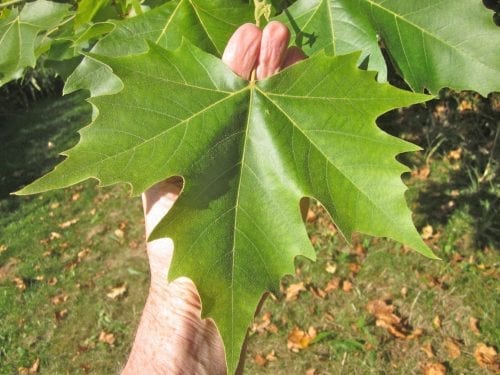
The leaf is large and has 5 main pointed lobes like a Maple. Each lobe has several teeth.

London Plane bark

The bark is unmistakeable, yellow patches remain after large brown flakes fall off. This is one factor which enables Plane trees to survive highly polluted urban environments. Soot blocks the breathing pores located in bark but by shedding polluted bark the tree avoids this problem.

London Plane female flowers

Close-up of the female flowers in May. Each sphere is made up of many individual flowers. Each female flower has 6 to 9 crimson stigmas.  Each stigma is linked by a style to an ovary which will develop into a single seed. 

London Plane male flowers

Male flowers shedding yellow pollen in May.

London Plane fruit

The fruit of the London Plane is a dense ball of individual fruits called achenes. Each achene consists of one seed with a style at the top and multiple hairs attached at the base. The styles stick out in this close-up photo. The hairs, which aid wind dispersal, are inside the ball at this stage. Photo taken in December. The seeds are dispersed in the following spring or early summer.

London Plane seeds

Seeds about to be dispersed from last year’s fruit in spring. The seeds are now hidden by the hairs which have elongated since December. Like dandelion seeds they are dispersed by the wind.

Two Horse Chestnuts

Two Horse Chestnuts

Native to Albania and Greece, the Horse Chestnut was introduced to Britain in 1616 and is now common in parks, village greens and city streets. It is easily recognised by its leaves, its spectacular flowers in spring and its production of ‘conkers’ in autumn. It can be confused with the Red Horse Chestnut, which is a hybrid between the Red Buckeye and the Horse Chestnut. It was introduced to Britain before 1818, after being discovered in Germany. It has been planted widely in Britain in parks, gardens and streets. Its crumpled leaves, red flowers and generally smaller size distinguish it from the Horse Chestnut. It is not long-lived.

A young Horse Chestnut in late May.

A Red Horse Chestnut in early May.

The flowers of the Horse Chestnut appear from late April to mid May, although some trees can be much earlier. This photograph shows the flowers fully open at the end of May. The flowers are arranged in a vertical cluster known as a ‘panicle’, sometimes called a ‘candle’. Flowers at the top are male, those at the bottom are female and those in the middle are bisexual. Female or bisexual flowers produce fruit when pollinated by bees.

The flowers of the Red Horse Chestnut are arranged like the Horse Chestnut but they are red. The colour is inherited from the Red Buckeye. Photo taken at the end of April. 

The fruit of the Horse Chestnut develops so that the  seed is  surrounded by a green spiky ‘husk’ by the end of August. The ‘husk’ splits ready for the seed – known as a ‘conker’ – to fall to the ground in September. 

The fruit of the Red Horse Chestnut is a capsule like the Horse Chestnut but the husk has fewer spines. The nut inside the husk is smaller than the Horse Chestnut ‘conker’. Photo taken near the end of October.

Whitebeam

Whitebeam

Common Whitebeam

The Common Whitebeam Sorbus aria is native to the south of England and south and central Europe. It grows best on chalk and limestone. It has been planted as an ornamental tree in many streets and gardens. The leaves are oval and toothed but their most obvious characteristic is that they are very hairy and white underneath. The tree bears white flowers in May and red berries in September Blackened old fruit stays on the tree all winter. Whitebeams, Rowans and Service Trees are all members of the Sorbus genus. There are 44 species and 8 hybrids in this genus in Britain. Some of them are very rare and endangered

Common Whitebeam tree

Common Whitebeam on a chalk hillside in May. Wild trees are often multi-stemmed but urban trees are usually single-stemmed.

Common Whitebeam flower cluster

White flowers in May. A flower cluster like this is called an inflorescence and takes the form of a corymb. Its structure can best be seen in the fruit photo. 

Common Whitebeam leaf

The underside of the green leaf is covered in white hairs. The leaf is oval-shaped and toothed.

Common Whitebeam fruit

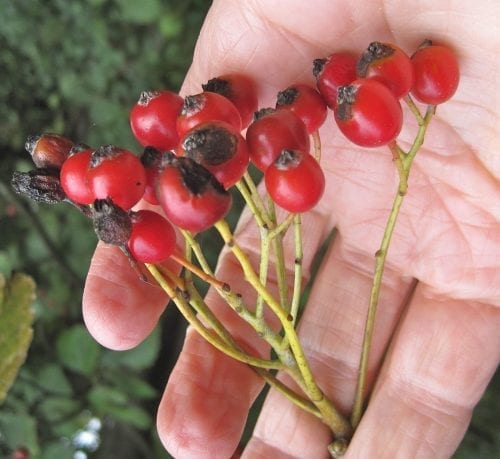
The fruit is bright red by the end of September. Technically the fruits are pomes not berries. Each flower in the corymb produces 1 red pome. In a corymb the outermost flowers have longer stems than those in the centre and so a flat head is produced.


Oak tree flowers

Oak tree flowers

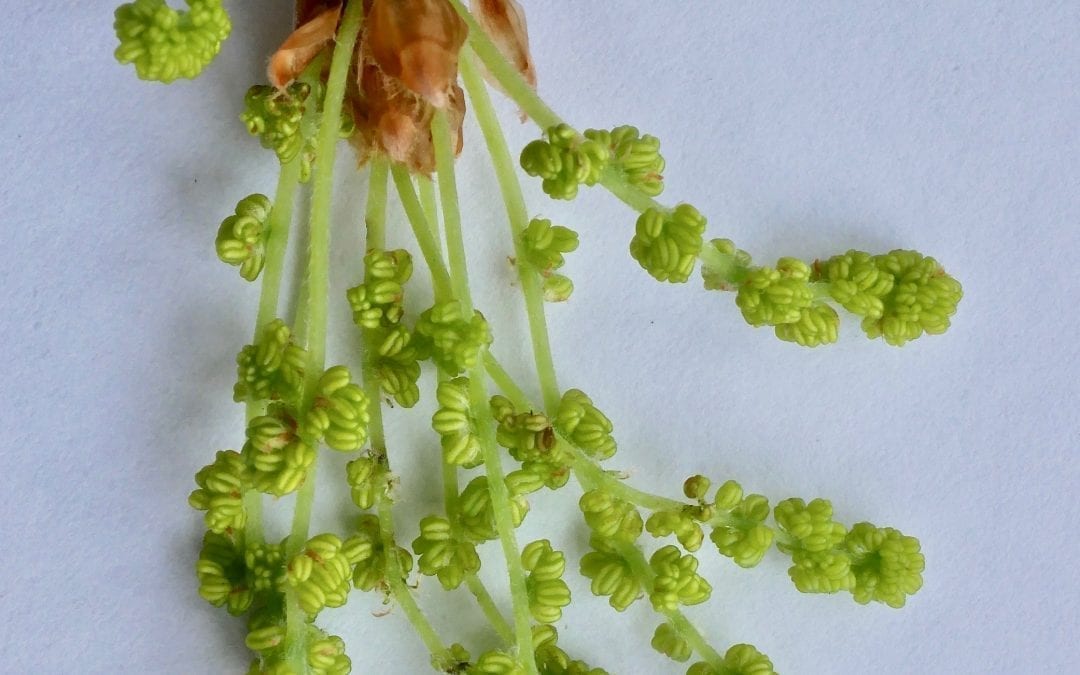
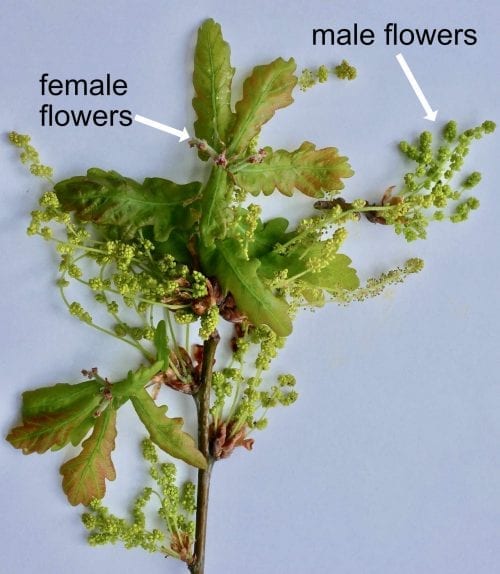
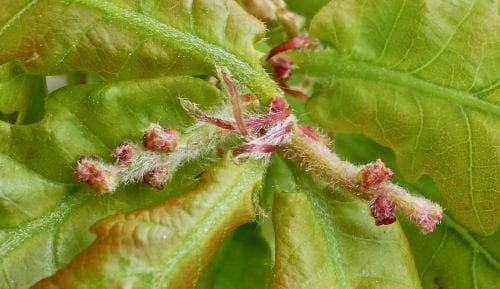
The English Oak is the dominant tree in most of Britain, particularly on the richer soils in valley bottoms. It has been planted everywhere in parks, gardens, deer parks and woods. It has male and female flowers on the same tree. Male flowers are on catkins and hang down, female flowers are small and red and located on short stalks called peduncles. Catkins release pollen in April and May and the red female flowers develop into acorns by autumn. The English oak acorns are on stalks but the closely related Sessile oak acorns have no stalks – they are sessile.

english oak female and male flowers
english oak male catkins
english oak female flowers
english oak acorns