Manchurian Cherry

Manchurian Cherry

The Manchurian Cherry is native to north-east China, Siberia and Korea. It was introduced to Britain in 1910. It was ‘discovered’ by Richard Maack and registered in 1857. It has white flowers that resemble those of the Bird Cherry. It is valued for its beautiful bark, honey-brown when young and red-brown when older. It was rare but can now be found in urban areas and can be confused with other white flowered cherries in spring.

Tree in blossom in mid-April.

Flowers are not yet open at the tip of this spike  but fully open at the base.

The flowers emerge with the leaves in mid April. The white flowers are on 7 cm long spikes similar to the Bird Cherry but unlike other Cherries.

The bark is honey-brown and glossy and has horizontal lenticel bands. The tree is prized for its beautiful bark.

Snowy Mespil

Snowy Mespil

Snowy Mespil identification – The Snowy Mespil, also known as the Juneberry, Snowy Mespilus or Serviceberry, is a deciduous shrub or small tree, originally from North America but now growing wild in Europe, including Britain. It is an ornamental tree planted widely in gardens for its delicate white flowers in early spring, red fruit in midsummer and red leaves in autumn. Amelanchier is a genus of up to 20 species. The fruit is very sweet when fully ripe. In North America Juneberry fruit is harvested in June or July and eaten as berries or converted to jams, jellies and wine. The fruit is also popular with birds.

Snowy Mespil identification is by its leaves, white flowers in spring, red fruit in autumn and long, beech-like buds in winter.

Tree in April

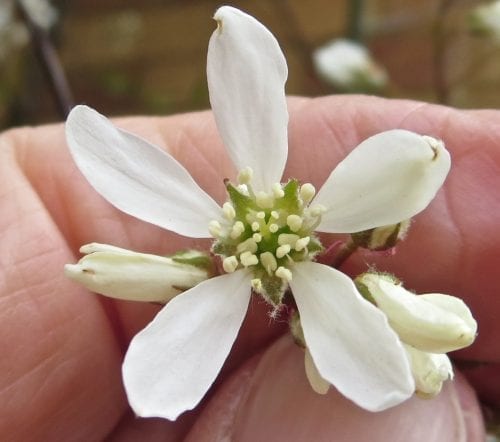
snowy mespil flower

Flowers come out with the leaves in April. Each flower has 5 petals.

Berries are red in June/July. They turn black in autumn.


Tree in May

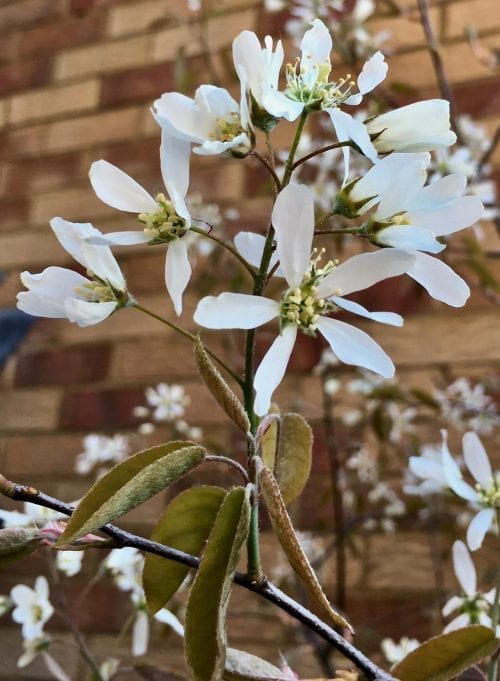
snowy mespil raceme

The flowers are in a raceme where 3 to 8 flowers are located close to a central stem.

Buds are alternate

Leaves are oval, parallel-sided and toothed

Buds are coppery and long, like a Beech

Cherry Blossom in Spring

Cherry Blossom in Spring

Cherry blossom in Europe is usually taken to include those cherry trees that have white or pink flowers in spring and are in the genus Prunus. Known as Ornamental Cherries they include the spectacular Japanese Flowering Cherries but also many other species and varieties that are available through garden centres and nurseries. The flowering season lasts 8 weeks from late March to early May with each species or variety flowering for two to three weeks. The majority flower in April. Dates when photos were taken are shown. Click on any photo to enlarge it.


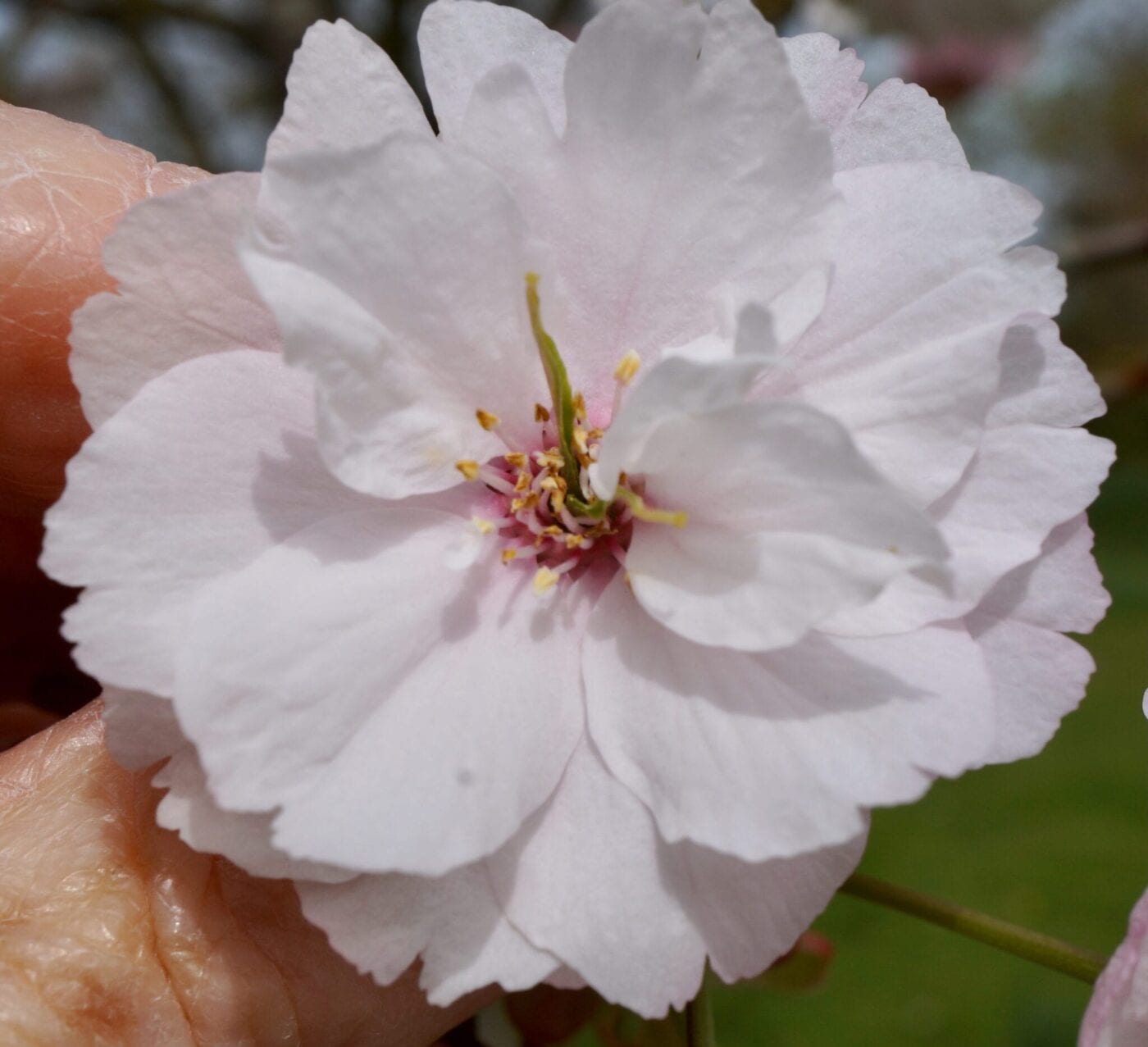
Cherry flowers may be white or pink and have varying numbers of petals.  A  ‘single’ flower has 5 petals, a ‘semi-double’ flower has 2 rows of 5 petals and a ‘double’ has 3 or more rows. ‘semi-double or double’ flowers arise when some of the rows of anthers  become petals. 


Wild Cherry flowers

The Wild Cherry Prunus avium is widely planted in new woodlands, parks, gardens and streets. It has ‘single’ flowers.

Wild Cherry cultivar 'Plena'

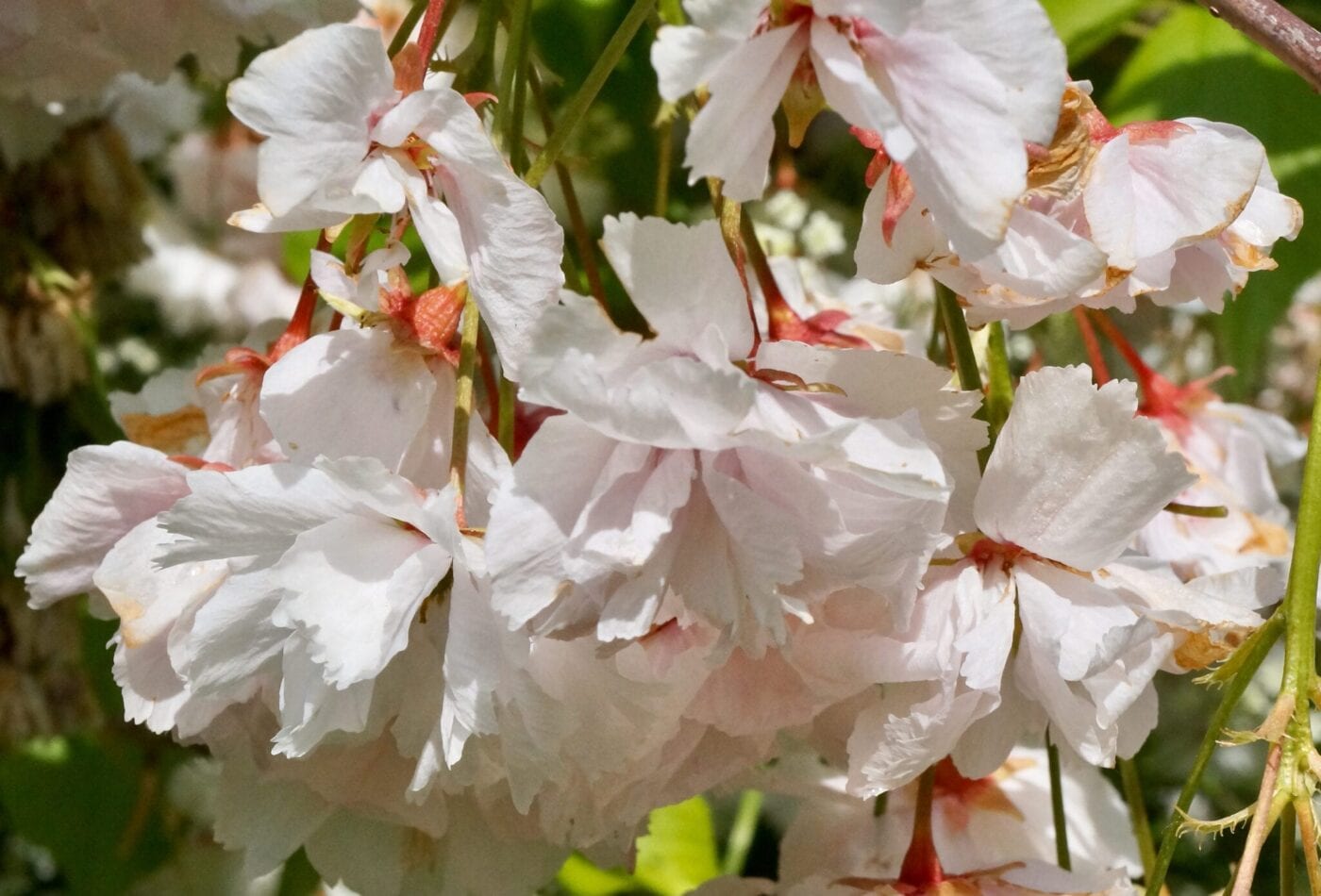
The Wild Cherry cultivar ‘Plena’ has white ‘double’ flowers. Each flower has up to 30 petals.

Japanese Flowering Cherries are a large group of cultivars that were bred in Japan from the 15th Century and were known collectively as Sato Zakura (village cherries). Their taxonomic origin is unclear but one of their parents is believed to be the Japanese Cherry (Prunus serrulata), native to northern and central China, Korea and Japan. The flowering cherries were introduced to Britain as early as 1822. They bear white or pink flowers in spring. There are more than 20 cultivars on sale in Britain. Some examples are shown here.


'Kanzan' Cherry tree

‘Kanzan’ has pink ‘double’ flowers in spring before the leaves. Mid April.

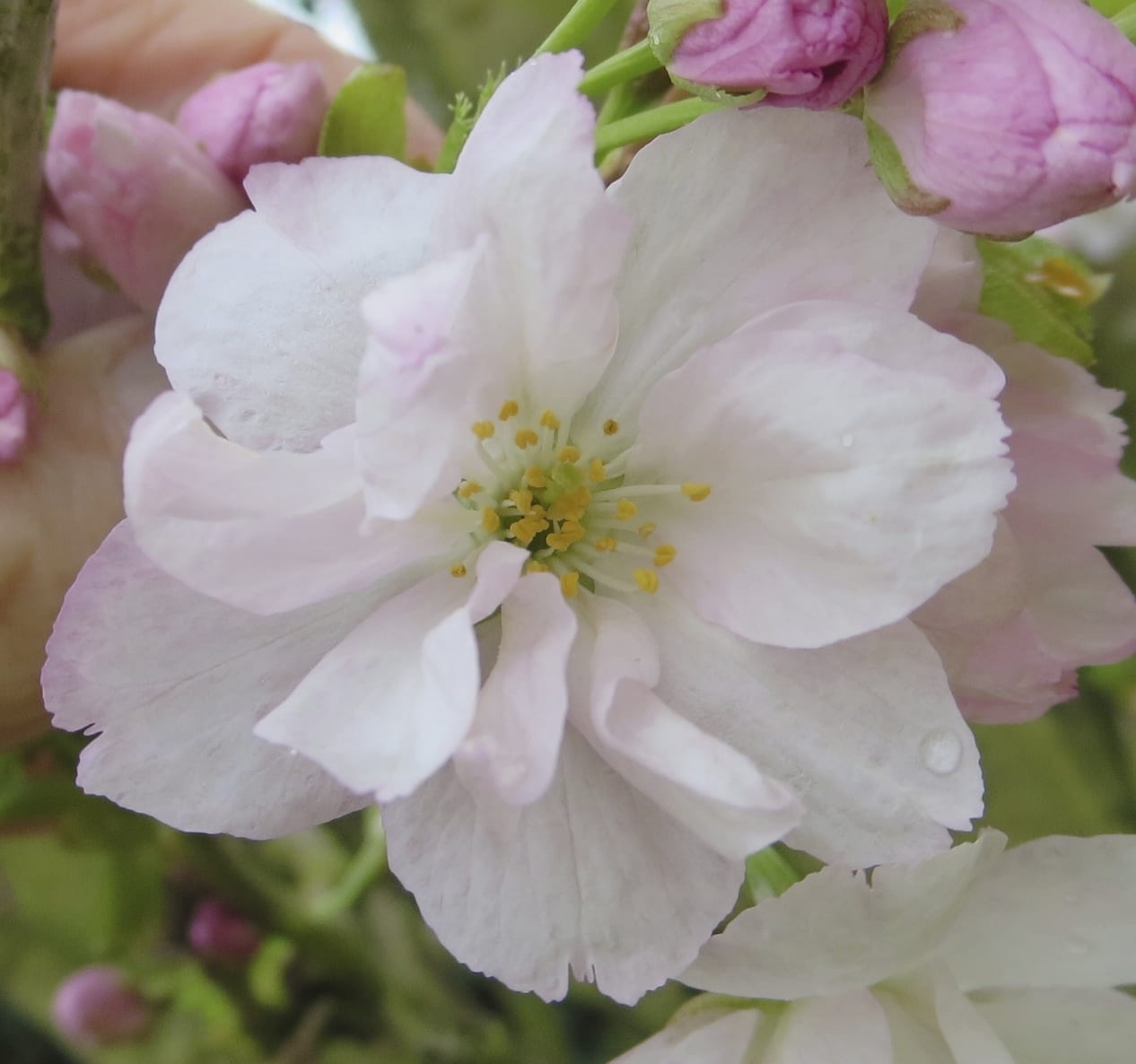
'Kanzan' Cherry flower

Each ‘Kanzan’ flower has 25 to 28 petals.

'Amanogawa' Cherry tree

‘Amanogawa’ has a vertical shape. Mid April 

'Amanogawa' Cherry flower

‘Amanogawa’ has ‘semi-double’ pale pink flowers.

'Shirofugen' Cherry flower

‘Shirofugen’ has pink/white ‘double’ flowers and is one of the last to flower in spring.  Each flower has 25 or more petals. End April.

'Tai Haku' Cherry flower

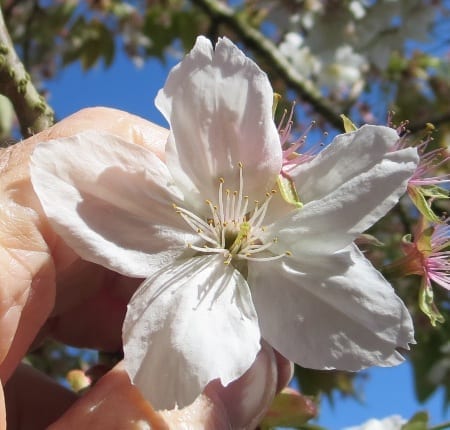
‘Tai Haku’, also known as the Great White Cherry, has very large, white, ‘single’ flowers and big leaves. Mid April

‘Ichiyo’ has beautiful ‘double’ pale pink flowers. Mid April.

‘Ukon’ has ‘semi-double’ pale yellow tinged flowers. Mid April

‘Cheal’s Weeping’ has deep pink ‘double’ flowers. Early April

‘Shogetsu’ has ‘double ‘ pure white flowers.  End April

Many other Cherry species and their varieties flower in spring and although not as spectacular as the Japanese Flowering Cherries still add to the overall  display. 

Sargent’s Cherry Prunus sargentii has ‘single’ pink flowers. Late March

Manchurian Cherry Prunus maackii  has ‘single’ white flowers in a cluster. Early May.

Tibetan Cherry Prunus serrula has small white ‘single’ flowers.  Late April. Planted mainly for its polished mahogany-like red-brown bark. 
Trees in flower in Spring

Trees in flower in Spring

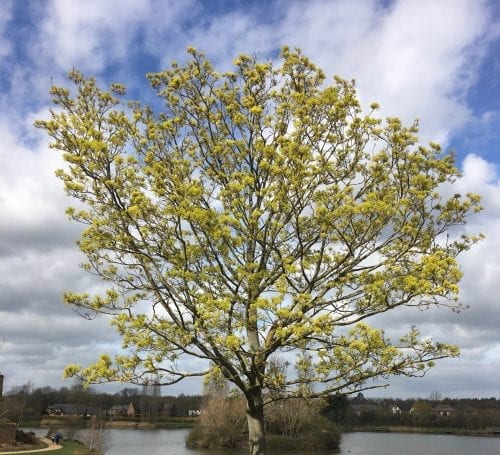
Two trees come into flower at the same time  in early spring. The Common Pear has white flowers and the Norway Maple has green flowers. Viewed from a distance one tree looks white and the other green.

Common Pear in flower

The Common Pear, also known as the Wild Pear, is probably of West Asian origin. It has been planted in parks, orchards and gardens and is occasionally found in hedgerows. There are hundreds of varieties of Pear, cultivated for their edible fruit. The leaves are toothed and glossy and variable in shape. The bark is deeply cracked into squares. The white flowers come out before the leaves in March/April. The fruit ripens by September.

Common Pear flower

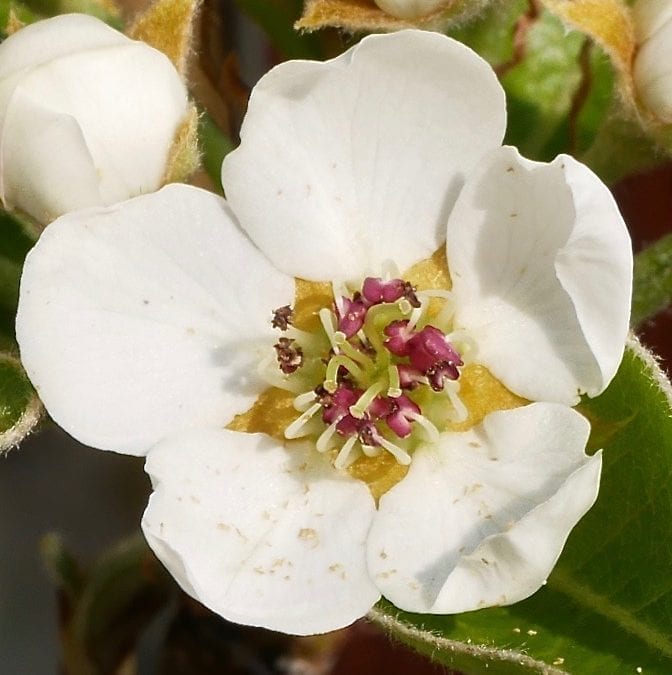
The flowers come out in March/April at the same time as the leaves, usually two weeks before the Apple. Pear flowers have deep red anthers but Crab Apple flowers have yellow anthers.

Norway Maple in flower

The Norway Maple is native to Europe, from Scandinavia to the Caucasus. It was introduced to Britain in 1683 and is now commonly found in gardens, streets and parks. It is one of the first trees to look green in spring, when its green flowers open before the leaves. It has the 5-lobed leaf typical of the Maple family but differs from the Field Maple and Sycamore in that its lobes and teeth have finely pointed tips. It has a winged fruit like all maples but the wings hang down at an angle whereas on the Field Maple they are flat.

Norway Maple flowers

The tree is one of the first trees to go green in spring but not with new leaves. Green flowers appear before the leaves and give the tree a green appearance in March or early April. The flower clusters burst out of the bud before the leaves.

Blackthorn

Blackthorn

Blackthorn Prunus spinosa                                                                                                                               

The Blackthorn is a small thorny tree or shrub, usually found in farm hedgerows, but often planted in urban areas. The fruit is called a ‘sloe’ and can be used to make wines and jam. The tree is often confused with the Cherry Plum (also called the Myrobalan Plum), which is described elsewhere in a post. The confusion arises because both have similar looking white flowers in spring. The difference is that the Cherry Plum comes into flower up to 4 weeks earlier than the Blackthorn. The Black and Brown Hairstreak butterflies lay their eggs on Blackthorn thorns in summer. The tiny eggs can be seen throughout the winter as white dots in the fork between the thorn and shoot. The eggs hatch out in spring. The Blackthorn flowers are formed before the leaves from March. The Blackthorn flower is smaller than that of the Cherry Plum and has a shorter stem and so seems to cling to the shoot. The leaves are small and toothed. The thorns are easy to see amongst the leaves.   The fruit was photographed in August and September.


Blackthorn tree August

Blackthorn trees in August

Blackthorn trees spring

The same Blackthorn trees in flower in early May after a cold spring.

Blackthorn leaf

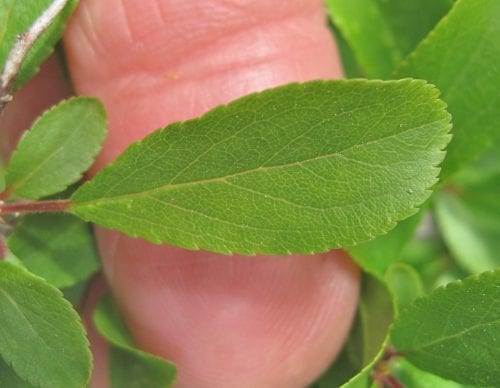
The leaves are small and toothed and tongue-shaped (wider near tip)

Blackthorn leaves and thorn

The thorns are easy to see amongst the leaves.

Blackthorn flowers

Flowers come out before the leaves at the end of March and last through April.

Blackthorn fruits

Fruit in August.

Blackthorn fruits

Fruit at the end of September. This type of fruit is called a drupe by botanists.

Blackthorn bark

Young tree bark.

Magnolias

Magnolias

Magnolia trees and shrubs are members of a very large genus containing between 120 and 230 species depending on the classification system used. The genus is named after the French botanist Pierre Magnol. It is an ancient genus with ‘primitive’ flowers adapted for pollination by beetles. The petals, for example, are known as tepals because the sepals and petals are indistinguishable. This is a feature common to plants that appeared early on in the evolution of Flowering Plants. Magnolias are important horticulturally. They are now sold worldwide and many new varieties have been developed. They are grown for their beautiful flowers and their striking foliage.

Magnolia trees and shrubs identification by flowers and leaves. Two common Magnolias, the Saucer Magnolia and Star Magnolia flower in Spring and the Southern Evergreen Magnolia flowers from midsummer. 

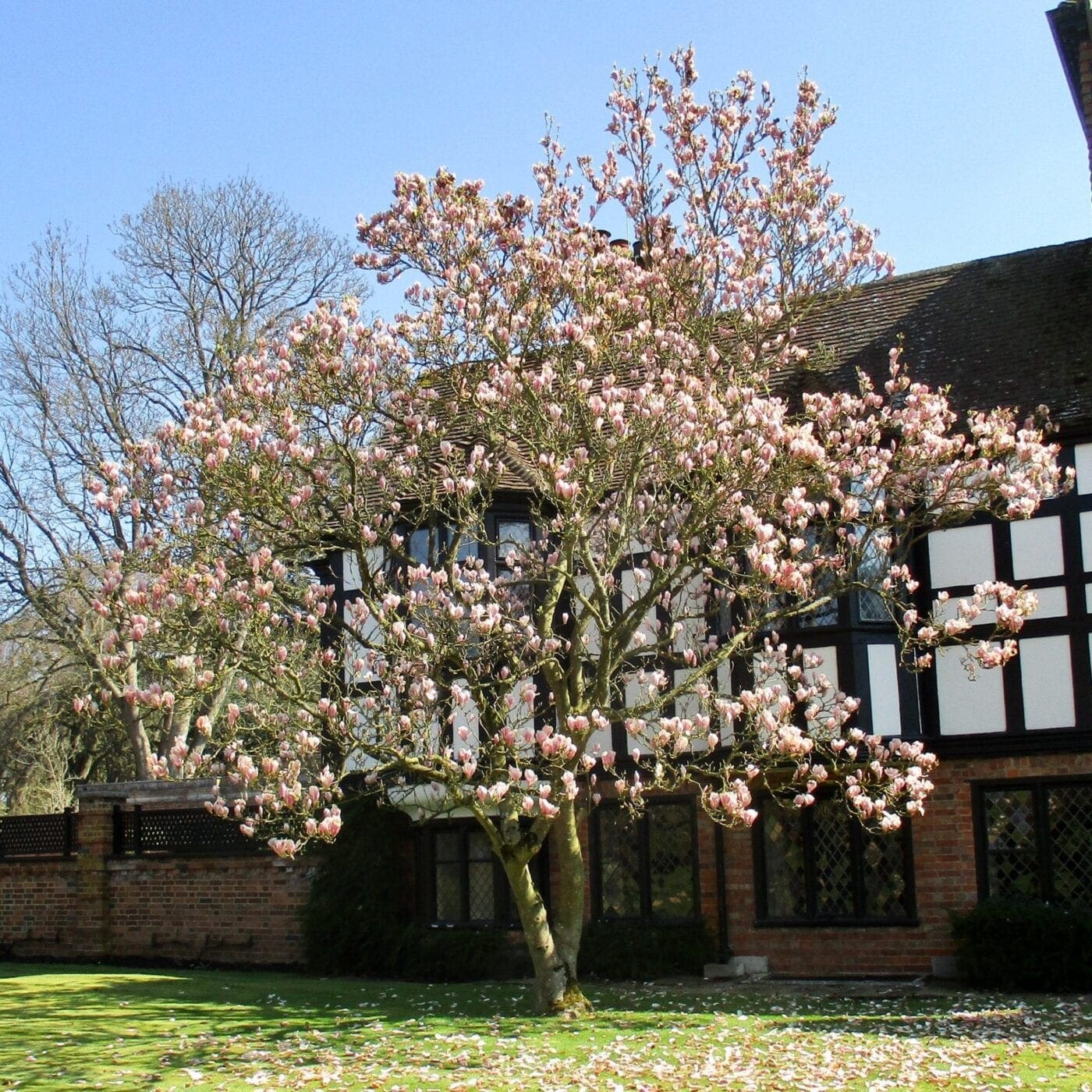
The Saucer Magnolia Magnolia x soulangiana, a deciduous shrub or small tree, is a hybrid between two Chinese species, Magnolia denudata (Yulan), which has white flowers and Magnolia liliflora, which has purple and white flowers. It was initially bred in 1820 in France by a retired cavalry officer Etienne Soulange-Bodin and was introduced to Britain in 1827. It is now the most popular and well-known form of Magnolia, widely planted in parks and gardens. It flowers in early spring, then through the summer.

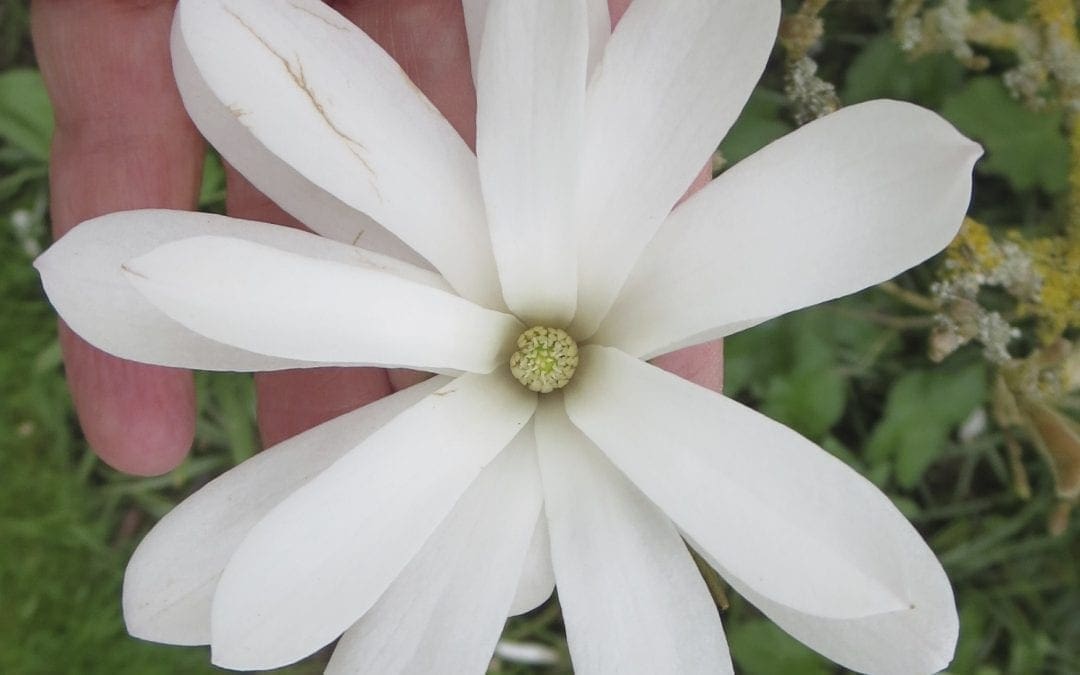
The Star Magnolia Magnolia stellata is a shrub or small tree very closely related to the Magnolia Kobushi. It is native to Japan and was introduced to Britain in 1862. It has star-shaped flowers with 12 or more strap-like tepals. It is a popular magnolia for small gardens, rarely exceeding a height of 3m.

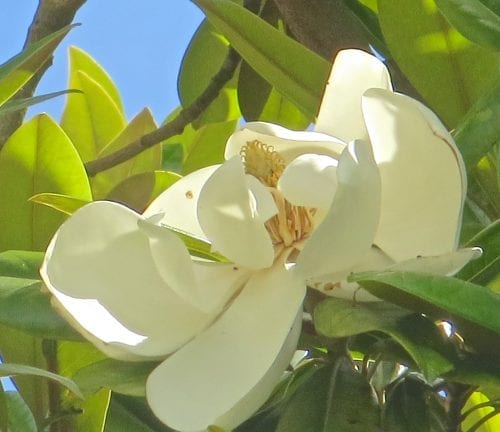
The Southern Evergreen Magnolia Magnolia grandiflora, also known as the Southern Magnolia or Bull Bay, is a large evergreen tree native to Southeastern USA. It was introduced to Britain in 1734. It is now common in warmer parts of Britain, where it was originally grown against south-facing walls. It has large, dark green leaves and beautiful white flowers.

Saucer Magnolia flower

The Saucer Magnolia vase-like flowers first emerge in March, before the leaves but continue to emerge through the summer. Flowers are white with a pink or purple stain. Photo taken March 19th.

Star Magnolia flower

The Star Magnolia flower has 12 or more strap-like tepals. The flowers appear before the leaves in March or April. This photo was taken on April 4th.


Southern Evergreen Magnolia flower

Each Southern Evergreen Magnolia flower  has 9 to 16 white tepals. They surround the yellow anthers and styles of the sexual parts of the flower. Flowers start to appear in midsummer and continue to appear until late autumn. Photo taken in July

The Saucer Magnolia leaves are large, up to 18cm.

The Star Magnolia leaves are smaller and narrower than other Magnolias.

The Southern Evergreen Magnolia leaves are large, glossy and bright green when young.